
How Arrest Warrants Work in Midland County
Michigan law draws the starting line. A complaint goes in under oath, and the judicial officer must find reasonable cause before signing an arrest warrant in Midland County. That finding only lets the case move forward. The local machinery sits with the 75th District Court, which issues arrest and search warrants, sets bail, accepts bond, and conducts misdemeanor and felony arraignments along with preliminary examinations. A felony that survives the preliminary stage moves up to the 42nd Circuit Court. Note: A warrant is a court order, while the arrest record is a separate document kept by the arresting agency.
Where a Midland County Arrest Warrant Begins
Before any arrest happens, paperwork decides the case. In Midland County, a police agency or the prosecutor drafts a complaint, and a judge either signs the order or denies it. MCL 764.1a governs the complaint, the finding of reasonable cause, and the electronic processes the statute allows in the circumstances it describes. For a searcher, the practical point is simple. A warrant belongs to a case file, and the case file lives with the court. The public county report shows a name, a case number, a current field, and a charge. Everything about how the warrant came to be sits in documents that report does not carry. The county Criminal Matters page spells out how criminal cases are filed and what happens at each early stage.
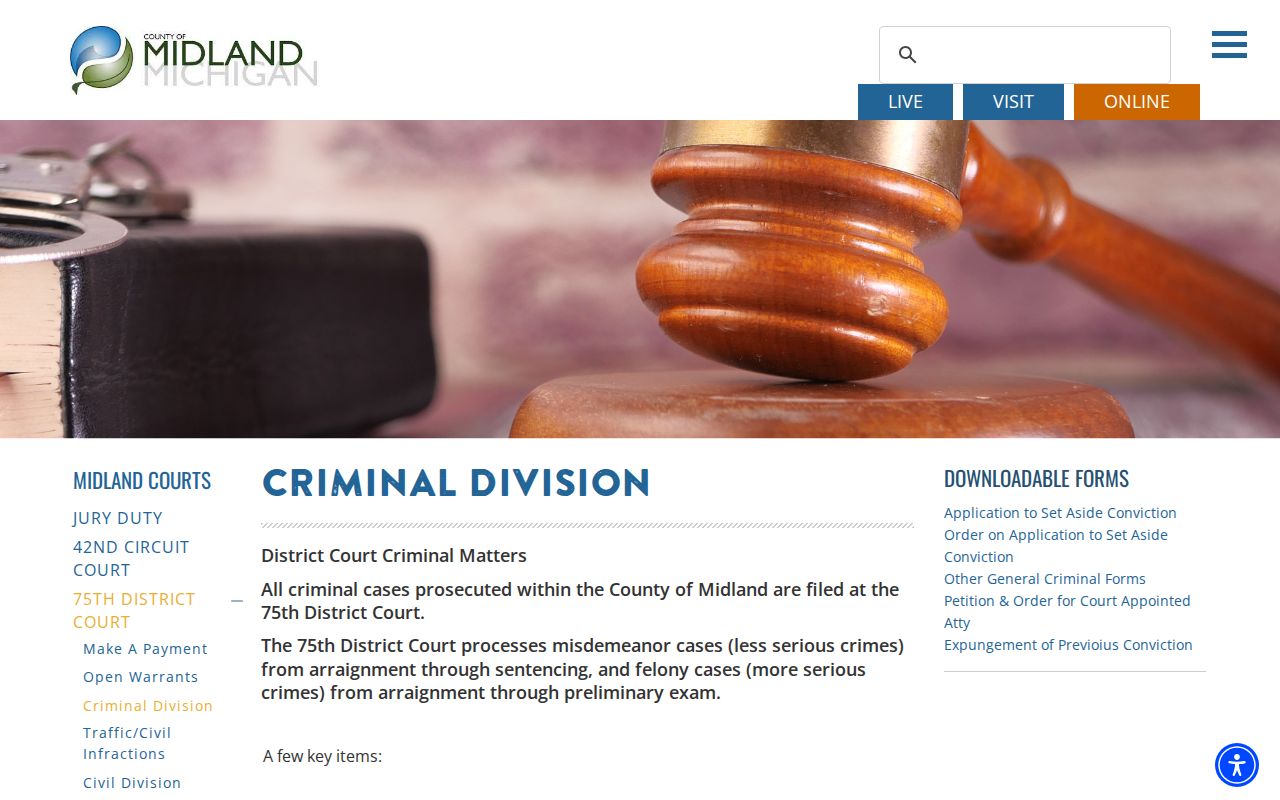
That filing step is what first puts a case and its warrant in front of a Midland County judge.
Arrest Warrants: What They Contain
A warrant document runs longer than any public listing suggests. The index is a summary. Midland County keeps the rest inside the case file. When someone asks what a warrant actually says, the honest answer is that the file holds more than a website will show.
| Case identity | A case number and the court that issued the order |
|---|---|
| Person named | The name as the court recorded it, printed on the public report as NAME |
| Charge basis | A sworn complaint and the offense alleged |
| Judicial finding | The reasonable-cause finding that supports issuance |
| Conditions | Bond and release conditions are addressed at arraignment |
| Return and service | Kept in the case file, not printed on the public report |
Who Serves a Midland County Warrant
Issuing a warrant and serving one are different jobs. The court signs. A Midland County law-enforcement agency carries the order out, and no agency here publishes a warrant-service roster or a public status lookup.
Midland County Sheriff's Office
2727 Rodd Street
Midland, MI 48640
989-839-4630
Records, jail, court security, civil process
Midland Police Department
Law Enforcement Center
2727 Rodd Street
989-631-5716
City police services and agency reports
Coleman Police handle nonemergency city matters at 989-465-1711, and the Michigan State Police Tri-City Post covers the wider Midland County area. Neither publishes a warrant list.
Note: The jail number answers custody questions only, and it is not a warrant-confirmation line for Midland County.
How Warrants Get Served in Midland County
The public rarely sees service coming. An officer or deputy in Midland County locates the person, makes the arrest, and books the case into the county jail when custody is required. The court then takes over for arraignment.
Warrant flow: complaint and finding › warrant issued › agency service or voluntary appearance › arraignment and bond › case continues in district or circuit court
Two practical details stand out. Anyone entering the Midland County courthouse passes a weapons screening, and the county says all parcels are subject to inspection. Plan for that line. If an arrest has already happened, the jail handles custody logistics while the court keeps the case. The Court Security page lays out the screening rules that apply to every visitor.
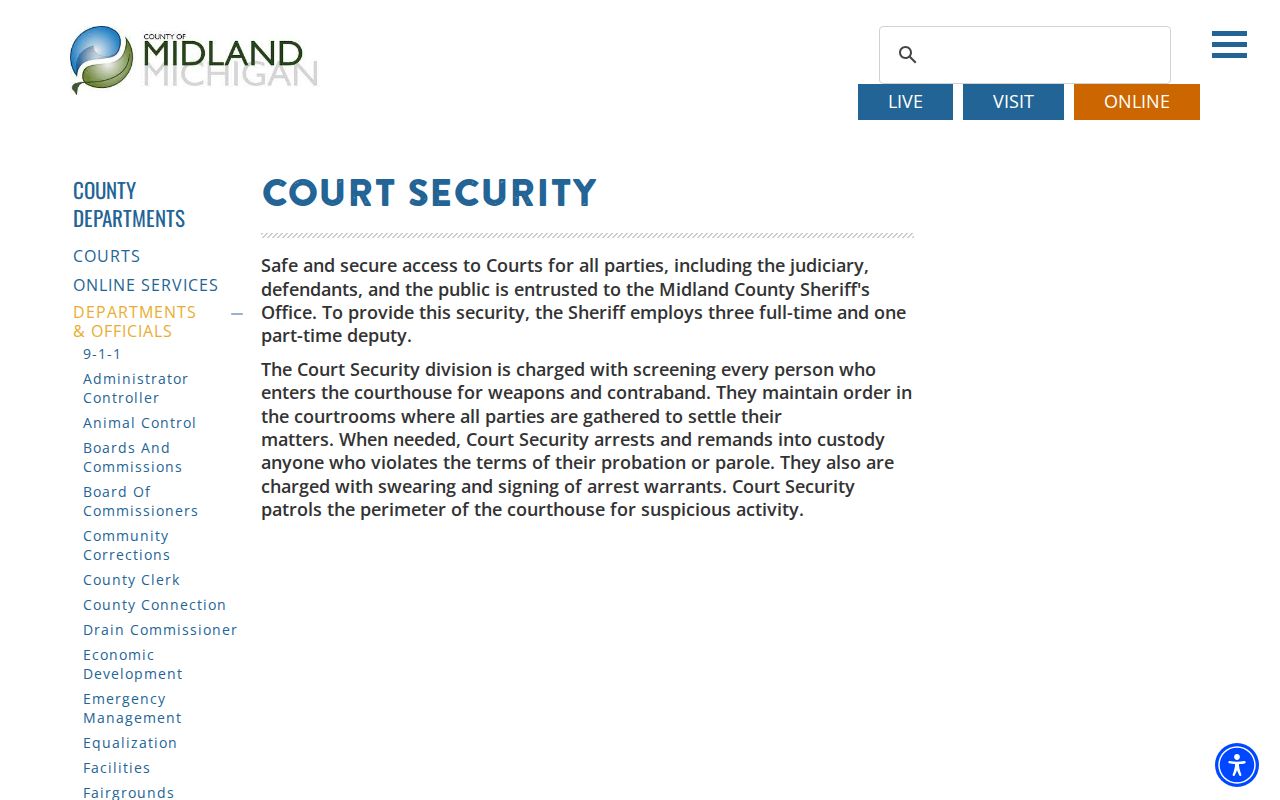
Expect a screening line at any Midland County court date. The process starts well before the courtroom door.
Felony Cases and Midland County Arrest Warrants
A felony can start in one court and finish in another. In Midland County, the district court runs the arraignment, where the charge, rights, possible penalties, and bond are addressed. Next comes the preliminary examination. Its job is deciding whether a crime occurred and whether the defendant may have committed it. Cases that clear that stage proceed to the 42nd Circuit Court, which handles felony and serious-misdemeanor matters, domestic relations, and appeals from lower courts. The public warrant report belongs to the district court. That means it is not a complete felony docket. The 42nd Circuit Court page lists that bench's jurisdiction and contact number.
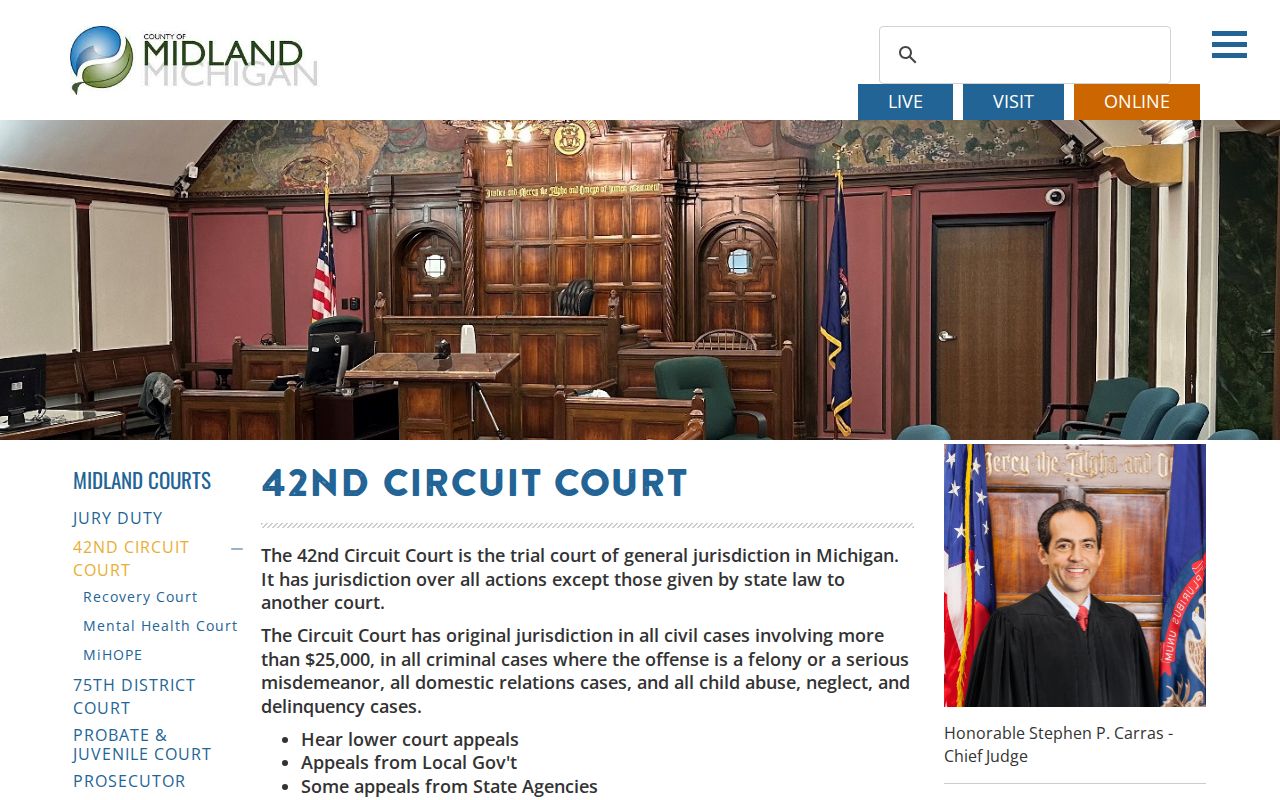
A Midland County felony file can have two court homes over its life, with the district court handling the early stages first.
Arrest Warrants, Summonses, and Bench Warrants
Michigan courts can reach a person in more than one way. A summons asks. A warrant authorizes custody, while a bench warrant pulls someone back into an existing Midland County case.
| Process | How it starts | What usually follows |
|---|---|---|
| Summons | A charge is filed and the court orders an appearance | A scheduled court date, with no custody beforehand |
| Arrest warrant | A sworn complaint and a reasonable-cause finding | Arrest or surrender, then arraignment and bond |
| Bench warrant | A missed date or a failure to comply in an open case | A return to the same case for a reset or hearing |
| Appearance ticket | An officer directs a person to appear later | A court date, and consequences if it is missed |
MCL 764.9e spells out what can follow an appearance ticket. In the cases it covers, Midland County judges get a presumption in favor of ordering a person to show cause.
What to Do When Someone May Have an Arrest Warrant
Move in a careful order and involve a lawyer early. What happens in the first few days of a Midland County warrant case often shapes everything after.
- Check the county open warrant report for its limited scope, and note the run date.
- Call the Criminal Department at 989-832-6702 or 989-832-6718 with the case number.
- Ask what the court needs next, and whether the matter is in district or circuit court.
- Consult a Michigan criminal-defense lawyer before deciding how or where to appear.
- Follow courthouse screening directions for any scheduled appearance.
Handling an Arrest Warrant in Your Name
A warrant with your name on it is a legal problem with a process attached. Ignoring it is the worst move. Midland County publishes a single path, and it begins with a phone call to the Criminal Department to arrange an arraignment date. The clerk, not hope, is the strategy here.
Important: Talk to a lawyer before turning yourself in. Voluntarily appearing with counsel is usually calmer than being stopped at a traffic light.
Bond is set by the court. Midland County publishes no warrant-specific bond schedule, so call the clerk and ask what applies to your case rather than guessing from someone else's outcome.
Federal Warrants for Midland County Cases
Federal cases never touch the county list. Midland County belongs to the Eastern District of Michigan, and the district's local rules assign it to the Bay City location. Anything federal, an arrest warrant, an indictment, or a supervised-release matter, will stay off the 75th District Court report no matter how often you check it. So keep the two systems straight before you start a warrant search, or you can burn an hour looking in the wrong place. For federal dockets, access runs through PACER. The U.S. Marshals Service handles fugitive apprehension for the district. One more wrinkle: sealed matters and grand-jury material may not show in a public docket at all. A missing federal entry proves nothing either way. Midland County residents with a federal question should search PACER first, then the Marshals if a name turns up.